If you’ve spent any time researching barndominiums, you already know the frustration. You find a floor plan you love, you start asking about financing, and suddenly every lender you talk to either has no idea what you’re building or hands you a pamphlet that’s clearly meant for a standard stick-frame home. That gap between what people want to build and what lenders actually understand is exactly why this guide exists.
Before we go any further — every single barndominium design featured in this article has a floor plan available. If you see something you like, you can get the actual plan. We’ll tell you how at the end.
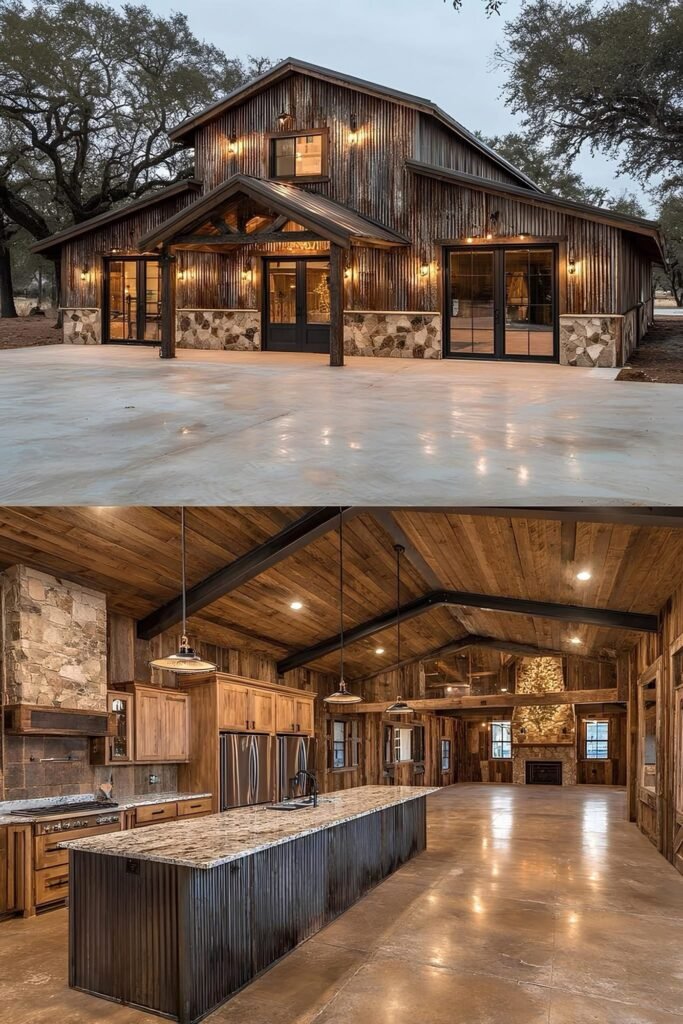
Barndominium 1
Estimated Build Cost: $420,000
Square Footage: 3,200 sq ft
Bedrooms/Bathrooms: 4 bed / 3 bath
Land Size: 2 acres
Notes: $420K, 3,200 sq ft home on 2 acres with rustic corrugated metal siding, stone base, gabled entry, and wide concrete frontage.
What Makes Barndominium Financing Different
The honest answer is that most lenders haven’t figured out how to box these buildings into their standard appraisal models, and that creates friction at almost every step of the process. A barndominium — whether it’s a converted metal agricultural building or a purpose-built post-frame home — doesn’t always have enough comparable sales in rural markets to satisfy a conventional underwriter. That’s not a dealbreaker. It just means you need to go into the process knowing which loan products actually work for this type of construction.
The three financing paths that consistently work for barndominiums are USDA loans, FHA one-time close construction loans, and conventional construction-to-permanent loans through portfolio lenders. Each has its own set of requirements, and choosing the wrong one early can cost you months of wasted time.
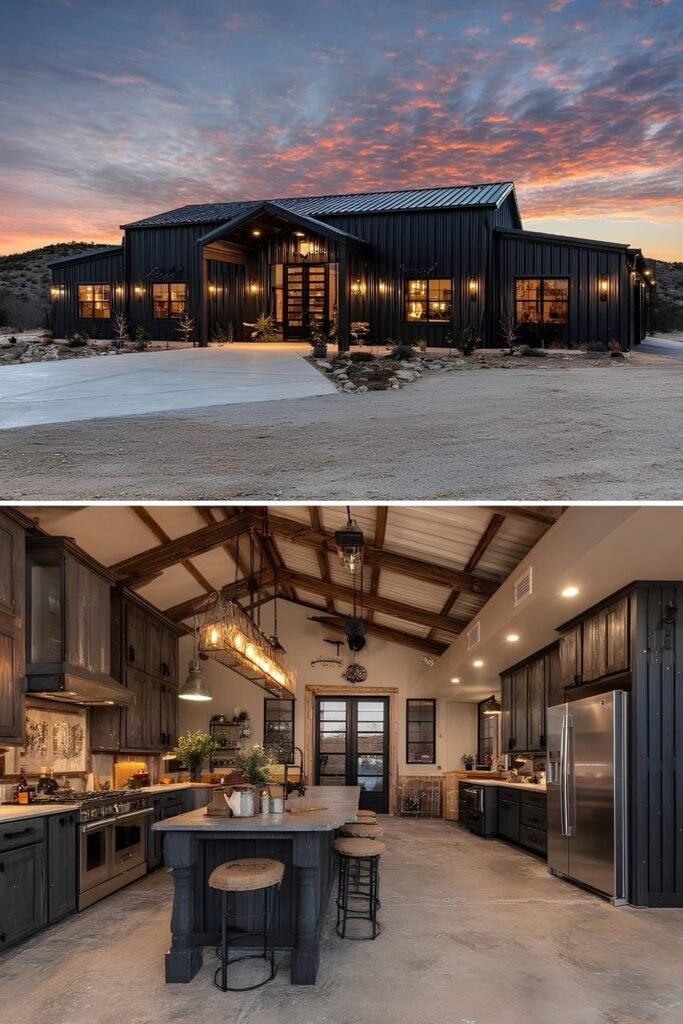
Barndominium 2
Estimated Build Cost: $360,000
Square Footage: 2,800 sq ft
Bedrooms/Bathrooms: 3 bed / 2.5 bath
Land Size: 1.5 acres
Notes: $360K, 2,800 sq ft black metal exterior on 1.5 acres with clean lines, central gabled entry, warm lighting, and desert-style landscaping.
USDA Loans — The One Most People Overlook
If you’re building in a rural or semi-rural area — and most people building barndominiums are — the USDA Rural Development loan is one of the strongest tools available. The zero down payment requirement alone sets it apart from nearly everything else on the market. But there’s a catch most articles don’t mention: the home must meet USDA’s definition of a “modest” dwelling, and the appraiser has to be able to find comparable sales within a reasonable radius.
In areas where barndominiums have been around for a decade or more, comps exist and appraisers know how to handle them. In markets where they’re newer, you may need to work with a lender who has experience ordering barndominium-specific appraisals and who knows how to coach the appraiser through it.
Income limits apply to USDA loans, and they vary by county. Most families building a $300,000 to $500,000 barndominium fall within them, but it’s worth checking before you fall in love with a plan.
One more thing worth knowing about USDA financing — the guaranteed loan program and the direct loan program are different products aimed at different income brackets. Most barndominium buyers will use the guaranteed program, which works through approved private lenders. The direct program is administered by USDA itself and targets very low and low-income borrowers. Both can work for barndominiums, but the guaranteed program is faster and has fewer restrictions on finishes and features. If your lender only mentions one option, ask about both.
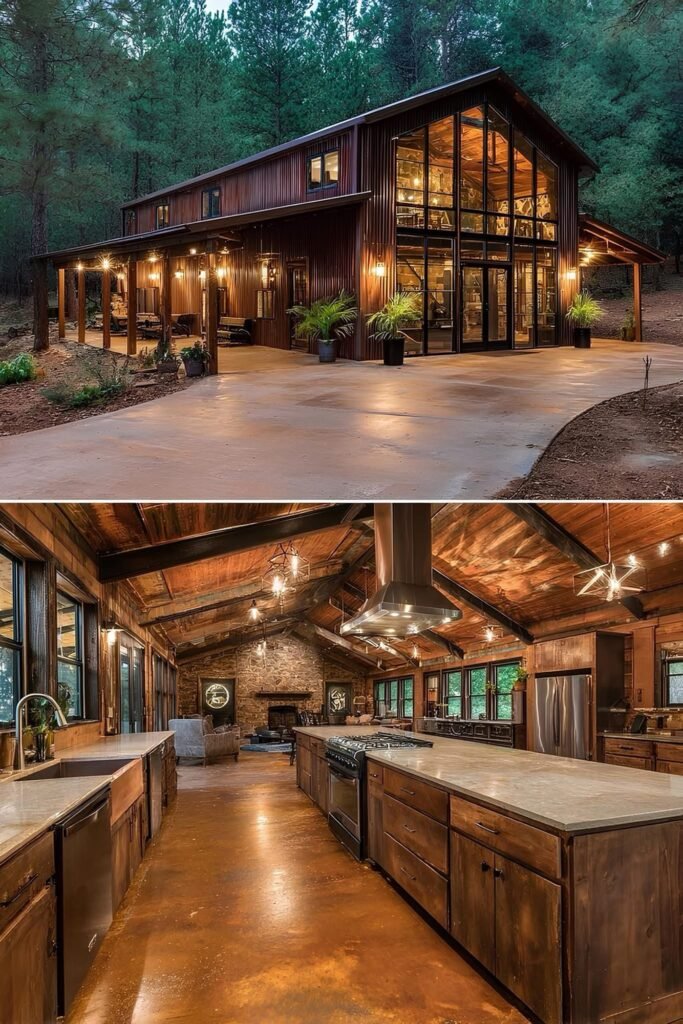
Barndominium 3
Estimated Build Cost: $475,000
Square Footage: 3,600 sq ft
Bedrooms/Bathrooms: 4 bed / 3.5 bath
Land Size: 3 acres
Notes: $475K, 3,600 sq ft home on 3 acres with tall glass wall, wraparound porch, dark brown metal siding, and wooded setting.
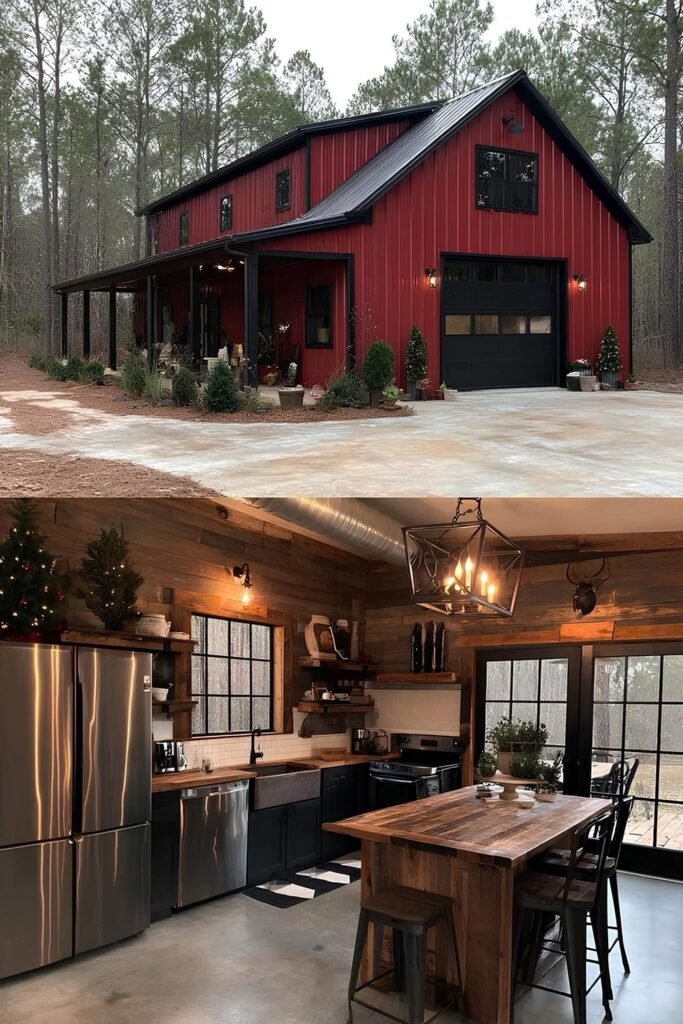
Barndominium 4
Estimated Build Cost: $310,000
Square Footage: 2,400 sq ft
Bedrooms/Bathrooms: 3 bed / 2 bath
Land Size: 1.8 acres
Notes: $310K, 2,400 sq ft red metal exterior on 1.8 acres with black trim, simple gable roof, attached garage, and covered porch.
FHA One-Time Close — Built for Custom Construction
The FHA one-time close construction loan is exactly what it sounds like. One closing. One set of closing costs. The loan converts from a construction loan to a permanent mortgage automatically when the build is complete. For someone building their primary residence, this eliminates the stress of re-qualifying after construction and locks your interest rate before the first nail goes in.
The 3.5% down payment requirement makes this accessible to a wider range of buyers than conventional financing. The tradeoff is that FHA has property standards your barndominium must meet — and some post-frame or metal building designs require additional documentation to satisfy those requirements. Work with a lender who has closed FHA construction loans on barndominiums specifically, not just someone who has done FHA loans in general.
Barndominium 5
Estimated Build Cost: $390,000
Square Footage: 3,000 sq ft
Bedrooms/Bathrooms: 3 bed / 3 bath
Land Size: 2.5 acres
Notes: $390K, 3,000 sq ft home on 2.5 acres with light metal siding, stone columns, symmetrical facade, and wide covered front porch.
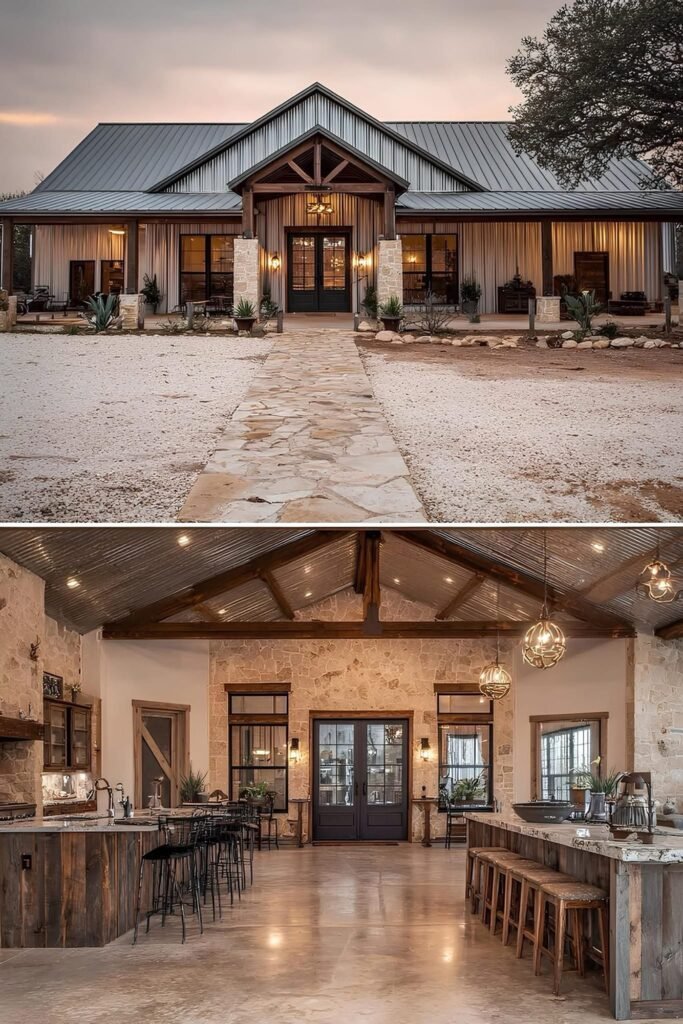
Conventional Portfolio Lenders — The Most Flexible Option
Portfolio lenders keep loans on their own books rather than selling them to the secondary market. That means they write their own rules, and many of them have developed barndominium-specific loan products over the past several years as demand has grown. You’ll typically need 10 to 20 percent down, strong credit, and a builder with a track record — but the approval process is often faster and less bureaucratic than going through a government-backed program.
Local community banks and credit unions are your best starting point here. Call them directly, ask if they’ve financed post-frame or metal building residential construction before, and get a sense of how familiar they are with the process. A lender who has done three or four of these is worth far more than one who has never seen one but thinks they can figure it out.
One thing that helps with portfolio lenders specifically is showing up prepared. Bring photos of comparable barndominiums in your area, particularly ones that have sold recently. If you can show the loan officer that there’s a market for these homes and that they hold their value — or appreciate — you’re making the underwriting conversation easier before it even starts. Some buyers work with a real estate agent who specializes in rural properties to pull those comps in advance. It’s not required, but it signals that you’ve done your homework, and lenders respond to that. The loan officer you’re talking to has to sell this to their underwriting team internally, and anything you can do to make that easier improves your odds of approval.
See Also >>> 35 Beautiful Small Barndominiums You Can Build for Under $100K (+ 10 Smart Reasons to Go Small)
Barndominium 6
Estimated Build Cost: $295,000
Square Footage: 2,200 sq ft
Bedrooms/Bathrooms: 3 bed / 2 bath
Land Size: 1.2 acres
Notes: $295K, 2,200 sq ft red-and-black exterior on 1.2 acres with simple barn form, attached garage, and minimal landscaping.
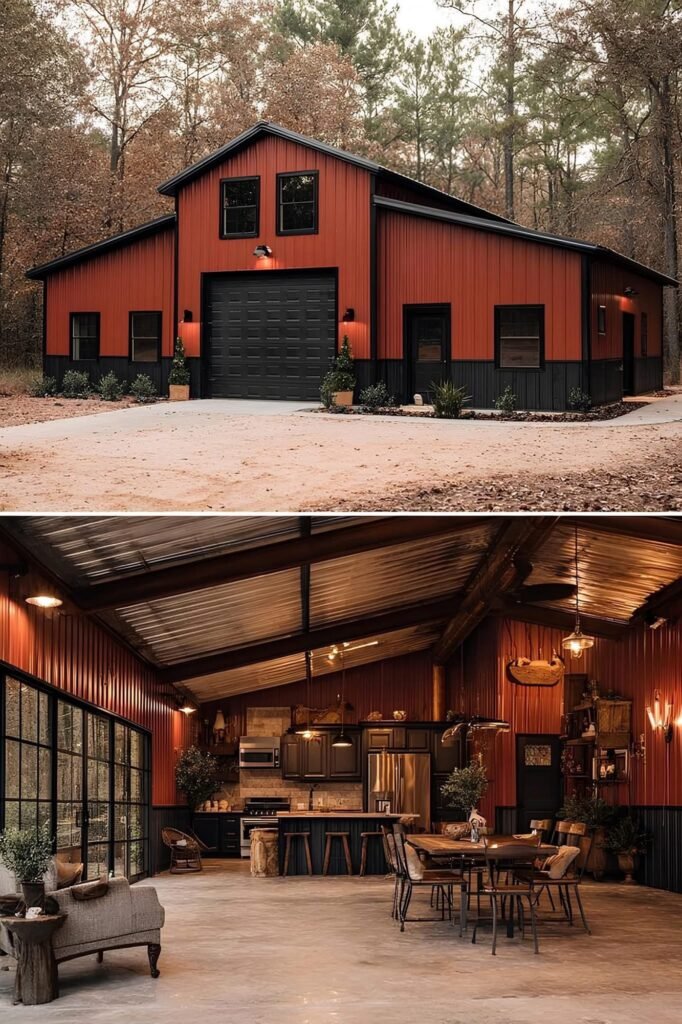
Barndominium 7
Estimated Build Cost: $405,000
Square Footage: 3,100 sq ft
Bedrooms/Bathrooms: 4 bed / 3 bath
Land Size: 2 acres
Notes: $405K, 3,100 sq ft home on 2 acres with light siding, stone base, expansive windows, and long covered porch.
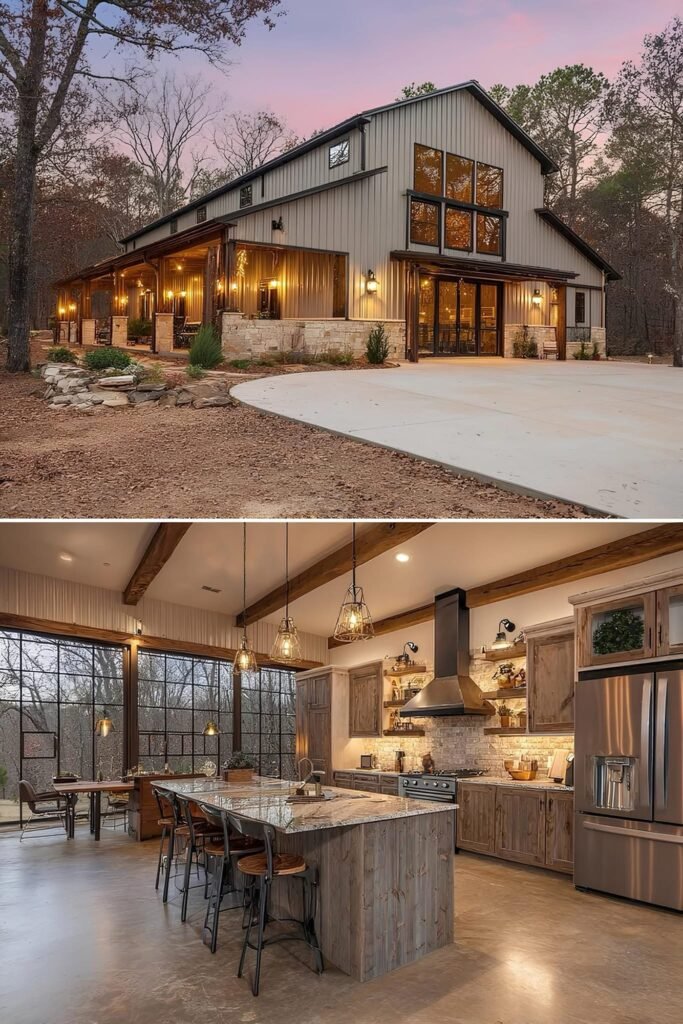
What a Barndominium Actually Costs to Build in 2026
The range you’ll see thrown around online — $50 to $200 per square foot — is technically true and practically useless. The real cost depends on your location, your finishes, whether you’re buying a kit or building from the ground up, and how much of the labor you’re handling yourself. Let’s break it down the way someone who has actually priced these things would.
A basic post-frame shell — walls, roof, concrete slab — typically runs $25 to $45 per square foot depending on the builder and the region. Once you start finishing the interior, that’s where costs accelerate. Spray foam insulation alone on a 2,000 square foot metal building can run $18,000 to $30,000. HVAC in an open-concept barndominium requires careful planning; the volume of air in a 20-foot ceiling space is fundamentally different from a standard eight-foot ceiling, and mini-split systems or engineered ductwork designed for the layout makes a significant difference in long-term efficiency.
Barndominium 8
Estimated Build Cost: $445,000
Square Footage: 3,400 sq ft
Bedrooms/Bathrooms: 4 bed / 3 bath
Land Size: 2.2 acres
Notes: $445K, 3,400 sq ft home on 2.2 acres with weathered wood siding, large upper window and wraparound porch.
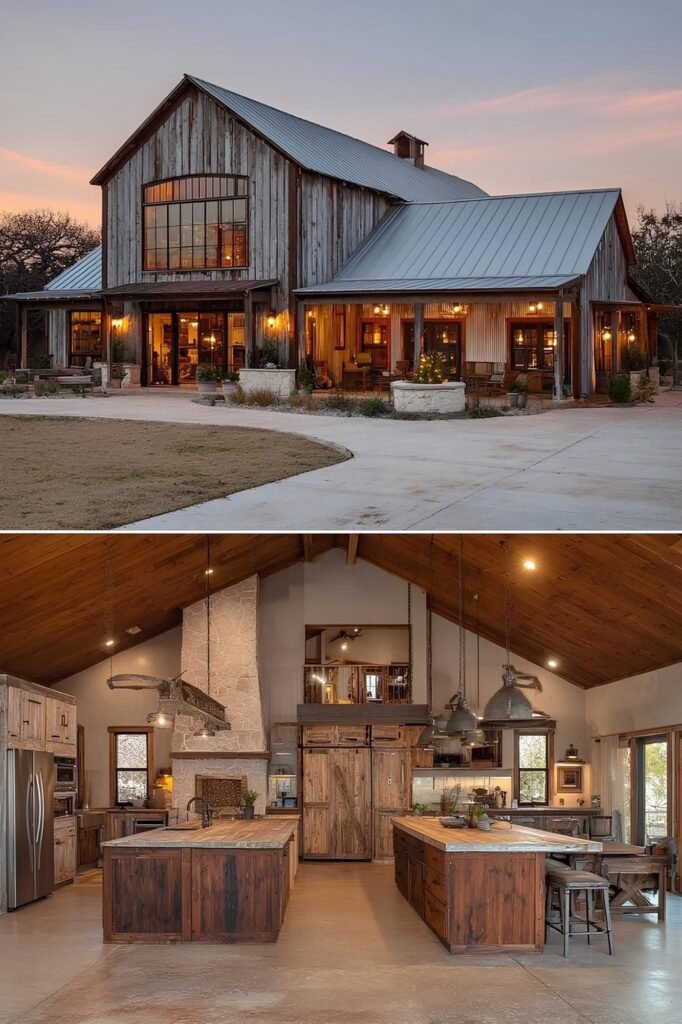
Barndominium 9
Estimated Build Cost: $335,000
Square Footage: 2,600 sq ft
Bedrooms/Bathrooms: 3 bed / 2.5 bath
Land Size: 1.6 acres
Notes: $335K, 2,600 sq ft home on 1.6 acres with light vertical siding, simple roofline, attached garage, and full-length covered porch.
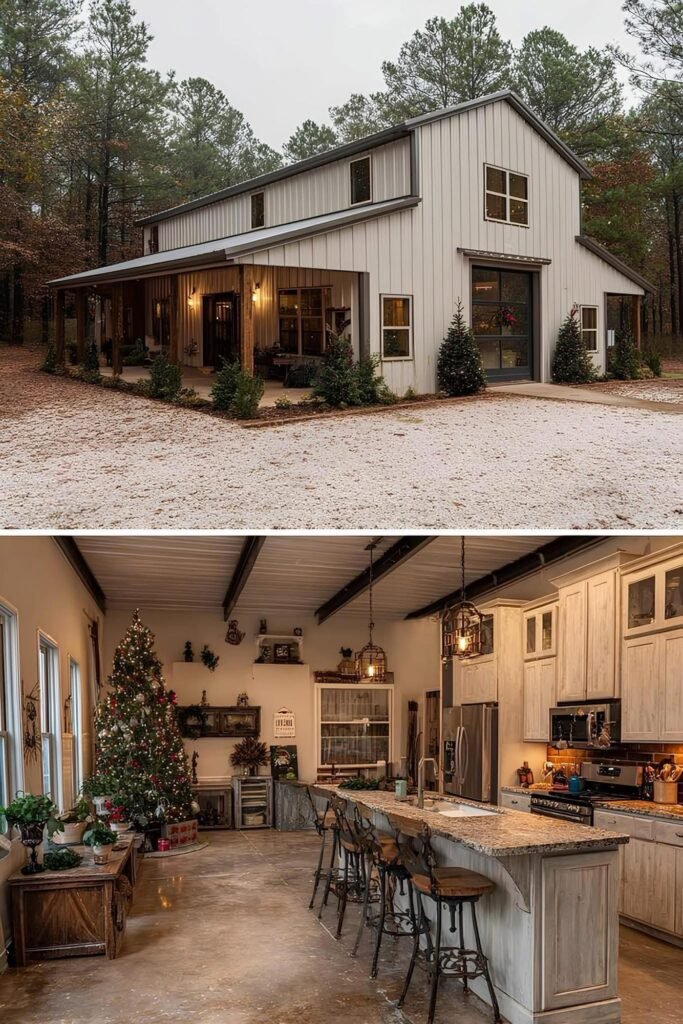
Electrical and plumbing costs are roughly comparable to standard construction, though routing through concrete slabs requires planning that can’t be changed later. Kitchen and bathroom finishes are where buyers have the most control over their final number. A barndominium with mid-grade finishes and efficient systems can come in well under $150 per square foot in most markets. A fully custom build with high-end stone countertops, commercial appliances, and premium fixtures will push toward $200 or beyond.
The designs in this article are specifically curated to show what $500,000 and under actually looks like when the planning is done right.
Most buyers also underestimate the cost of permits, engineering, and inspections. In many rural counties, permit fees are relatively modest — sometimes just a few hundred dollars for a residential build. But in counties that have recently updated their codes to address post-frame residential construction specifically, you may be looking at plan review fees, structural engineering stamps, and energy code compliance documentation that adds $5,000 to $10,000 to the pre-construction cost. Factor this in before you finalize your budget. Your builder should be able to give you a realistic estimate based on the county you’re building in.
Barndominium 10
Estimated Build Cost: $420,000
Square Footage: 3,200 sq ft
Bedrooms/Bathrooms: 4 bed / 3 bath
Land Size: 2 acres
Notes: $420K, 3,200 sq ft home on 2 acres with corrugated metal siding, stone base, gabled entry, and expansive concrete front.
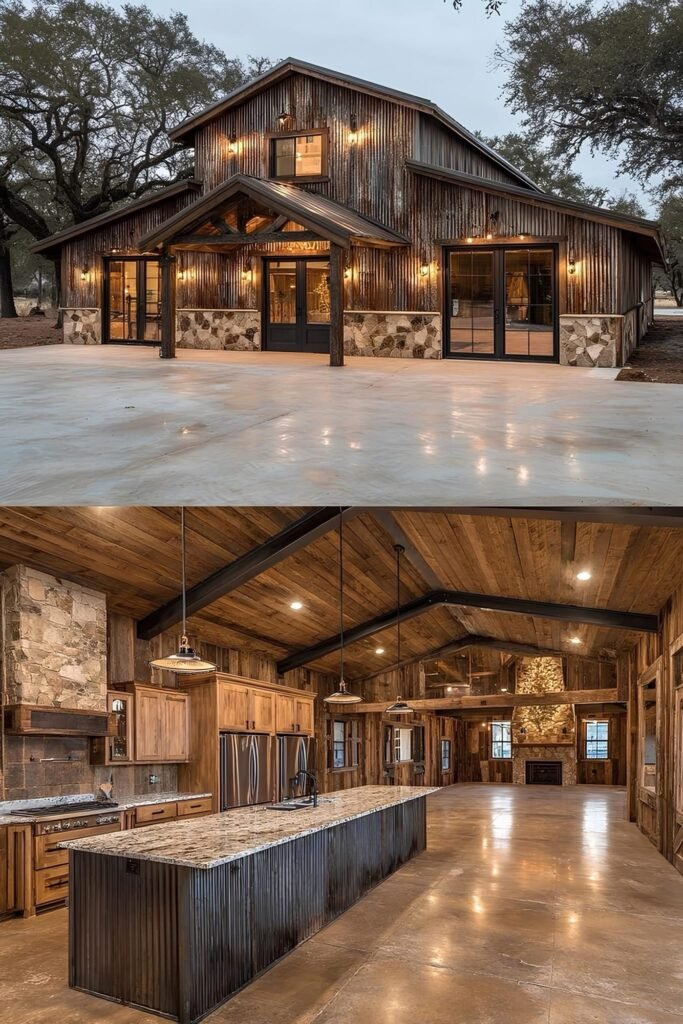
Land — The Variable That Changes Everything
A lot of barndominium budgets blow up before construction even starts because the land was underestimated. Rural acreage prices vary enormously — $5,000 per acre in parts of rural Texas is a real number, and so is $40,000 per acre in certain parts of the Southeast or Pacific Northwest. Beyond purchase price, site prep costs are often underestimated.
If your land requires significant grading, tree removal, culvert installation, or a long driveway, those costs add up fast. Well drilling can run $8,000 to $25,000 depending on depth and geology. Septic systems range from $5,000 for a basic system in sandy soil to $30,000 or more for an engineered system on challenging terrain. These aren’t optional — they’re required before you close on a construction loan.
Barndominium 11
Estimated Build Cost: $385,000
Square Footage: 3,000 sq ft
Bedrooms/Bathrooms: 4 bed / 3 bath
Land Size: 2 acres
Notes: $385K, 3,000 sq ft home on 2 acres with gray metal siding, stone base, wide porch, and classic rectangular barn form.
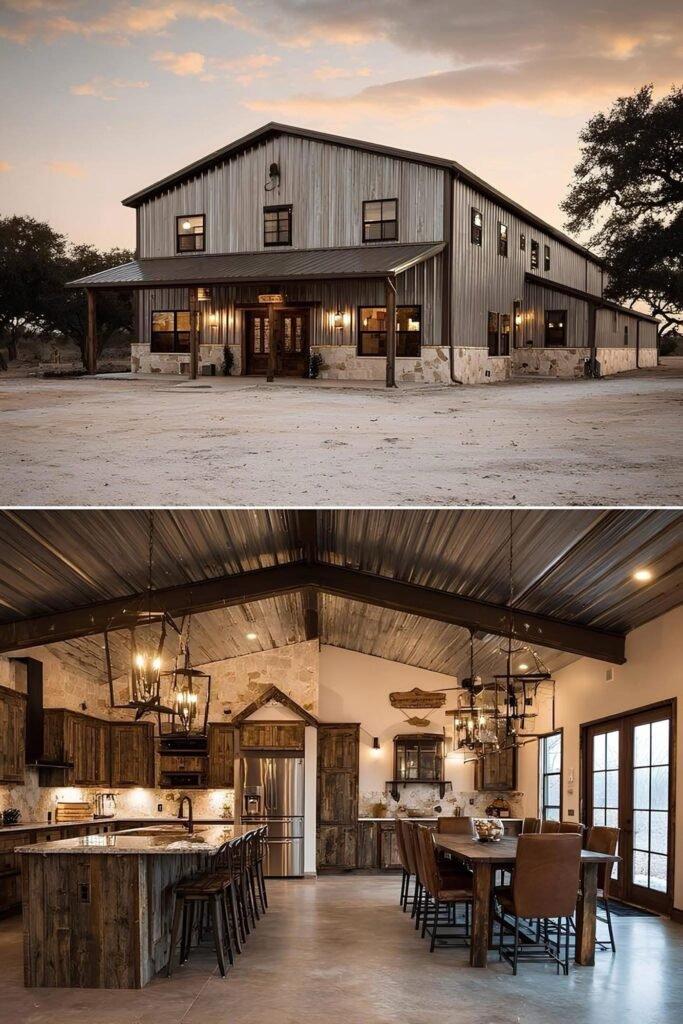
Barndominium 12
Estimated Build Cost: $370,000
Square Footage: 2,900 sq ft
Bedrooms/Bathrooms: 3 bed / 2.5 bath
Land Size: 2.3 acres
Notes: $370K, 2,900 sq ft home on 2.3 acres with dark metal siding, low roofline, wraparound porch, and wide glass garage door.
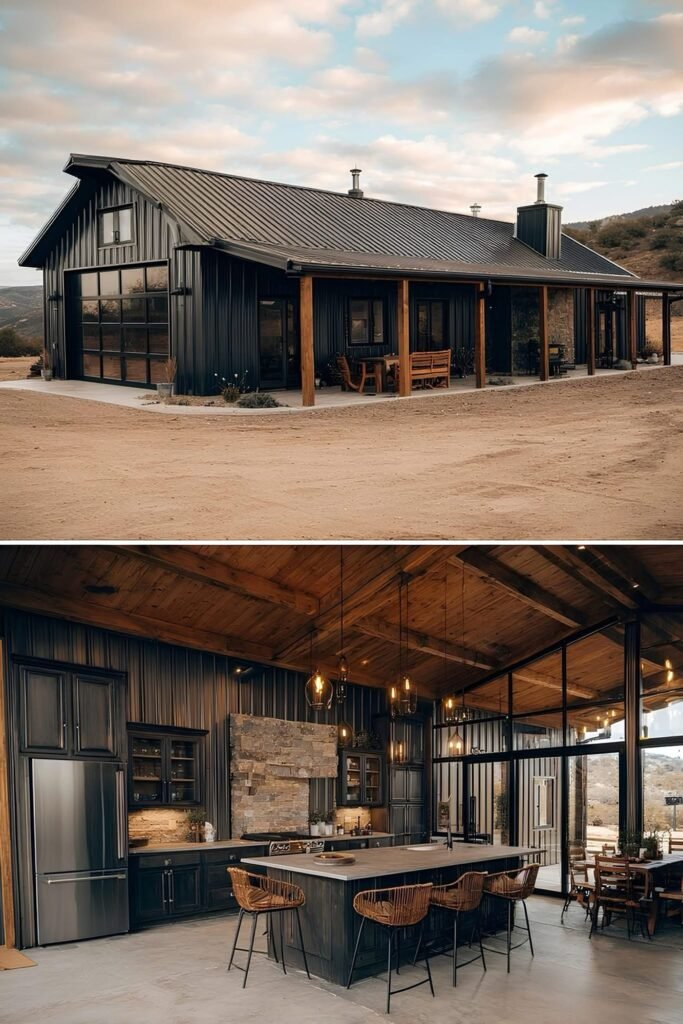
Get a site assessment done before you finalize your budget. A builder who has worked in your area will know roughly what to expect, and a soil engineer can answer the questions that matter most for septic and foundation planning.
Barndominium 13
Estimated Build Cost: $350,000
Square Footage: 2,700 sq ft
Bedrooms/Bathrooms: 3 bed / 2 bath
Land Size: 2 acres
Notes: $350K, 2,700 sq ft home on 2 acres with black metal siding, oversized garage opening, simple barn shape, and wooded backdrop.
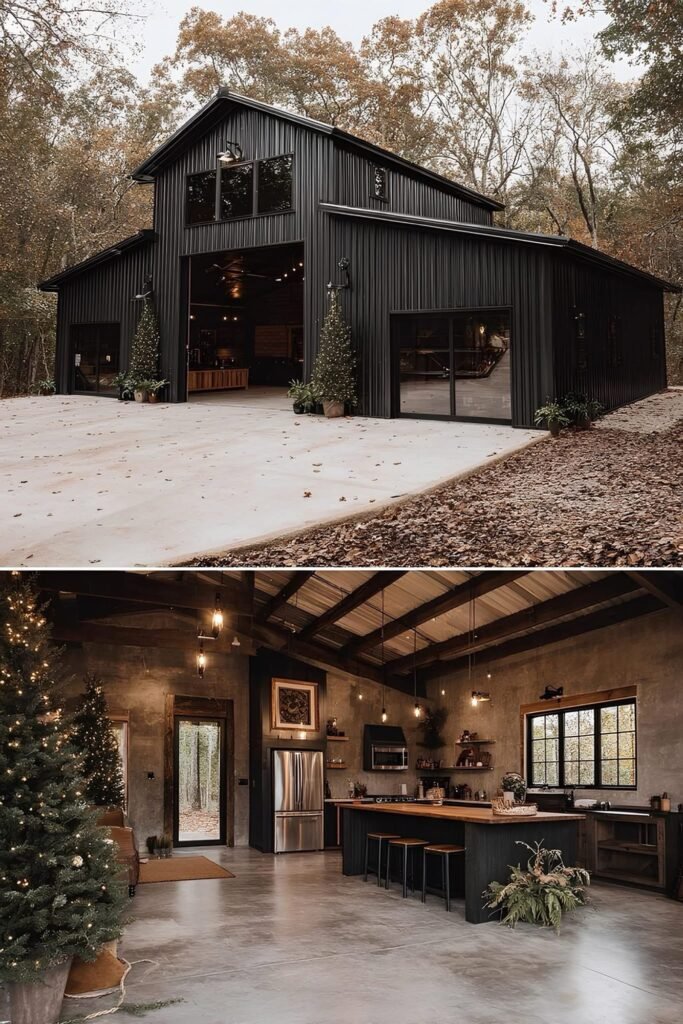
The Shell Kit vs. Custom Build Decision
Barndominium kits from manufacturers like Mueller, Morton Buildings, or General Steel have become more popular as lead times and pricing have become more predictable. A kit gives you engineered drawings, pre-cut steel components, and a building system that a local contractor can erect. The savings over fully custom construction can be meaningful — sometimes 15 to 25 percent on the structural portion of the build.
The tradeoff is design flexibility. Kit buildings come in standard widths and lengths, and customizing them beyond those dimensions often erases the cost savings. If your floor plan requires an unusual footprint — a wrap-around configuration, a specific window placement, or an integrated shop space with tall clearances — a custom builder may actually be the more economical path once you account for all the modifications a kit would require.
Barndominium 14
Estimated Build Cost: $365,000
Square Footage: 2,800 sq ft
Bedrooms/Bathrooms: 3 bed / 2.5 bath
Land Size: 1.7 acres
Notes: $365K, 2,800 sq ft home on 1.7 acres with black metal siding, sliding barn doors, steep roofline, and simple rural setting.
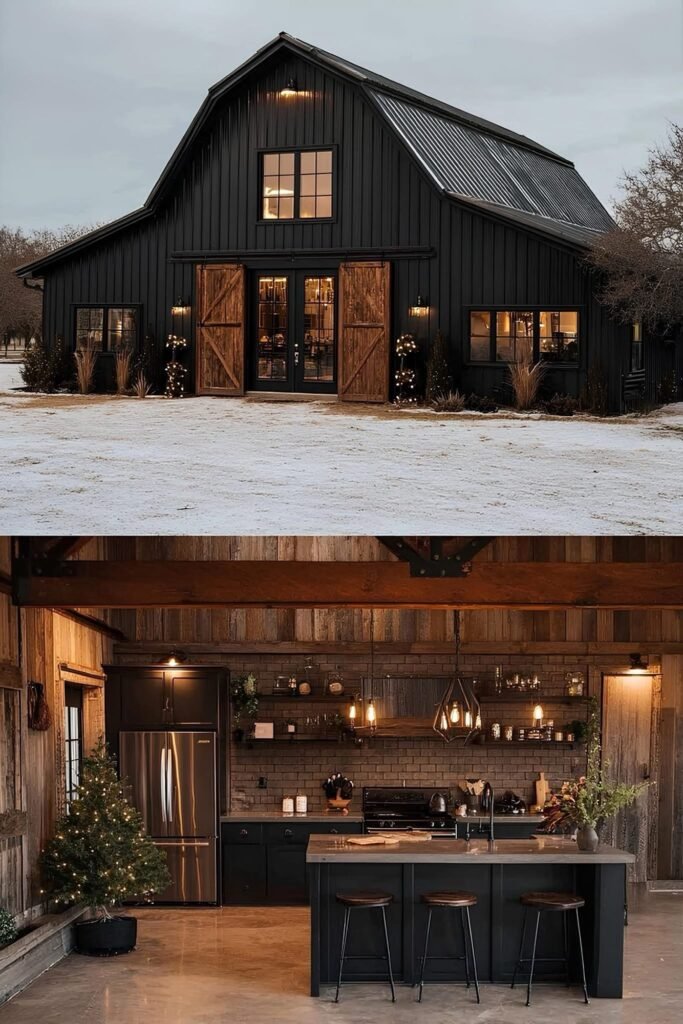
Barndominium 15
Estimated Build Cost: $430,000
Square Footage: 3,300 sq ft
Bedrooms/Bathrooms: 4 bed / 3 bath
Land Size: 2.4 acres
Notes: $430K, 3,300 sq ft home on 2.4 acres with symmetrical design, central gable, metal siding, and extended covered porches.
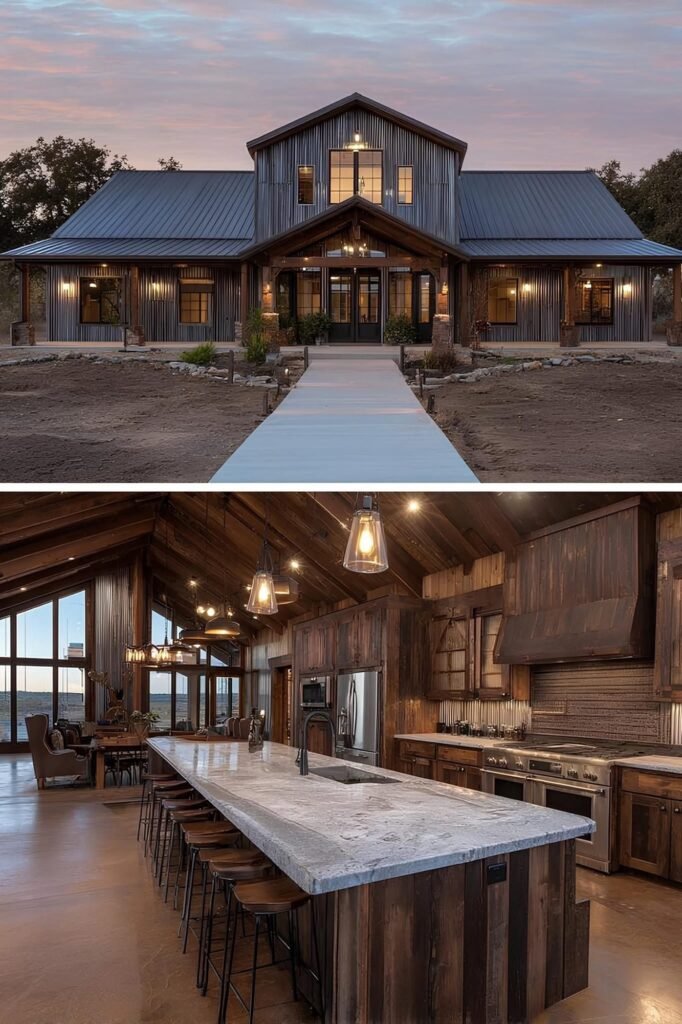
For buyers working with a fixed budget, kits offer something equally valuable: predictability. When you’re trying to satisfy a construction lender’s draw schedule and appraisal requirements, having engineered plans and a manufacturer’s warranty on the structure simplifies conversations considerably.
Barndominium 16
Estimated Build Cost: $320,000
Square Footage: 2,500 sq ft
Bedrooms/Bathrooms: 3 bed / 2 bath
Land Size: 1.5 acres
Notes: $320K, 2,500 sq ft home on 1.5 acres with white metal siding, gambrel-style roof, black accents, and clean, simple frontage.
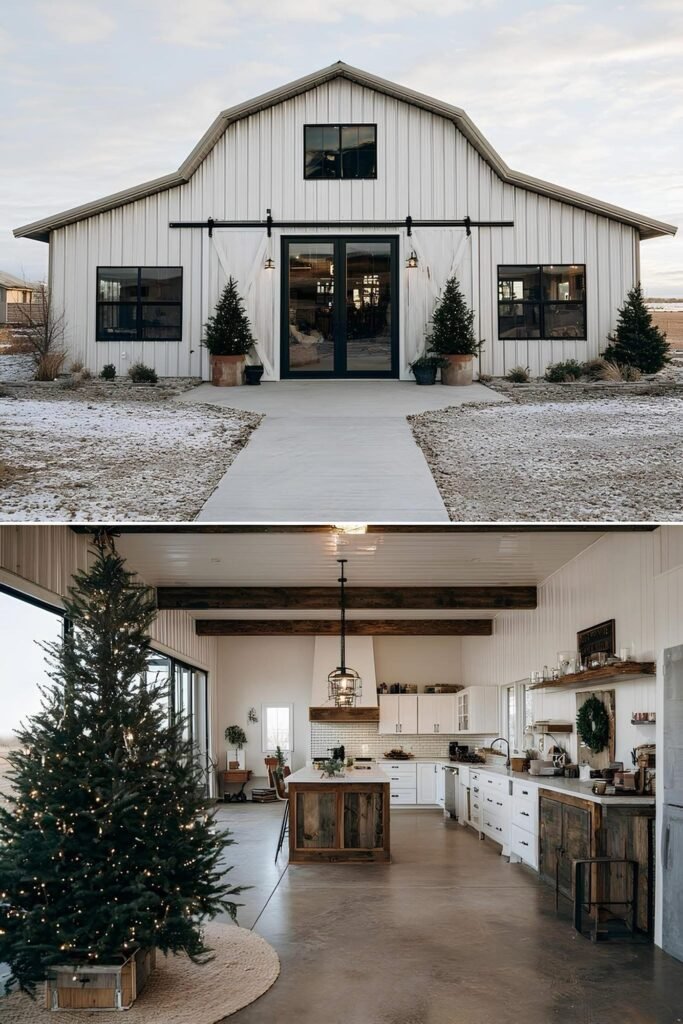
Design Features That Affect Cost More Than People Realize
Roof pitch matters more than most buyers think. A steep gable roof on a metal building costs significantly more than a lower-pitched gambrel or monitor style because of material quantity and labor complexity. But a lower pitch can also affect how the interior feels — a 4:12 pitch on a 40-foot wide building gives you meaningful loft potential, while a shallower roof keeps it tighter.
Window placement is the other area where decisions made on paper translate directly to the checkbook. Large picture windows and sliding glass doors are beautiful and they sell the lifestyle, but they’re also where your thermal envelope gets the weakest. In a metal building that already has some thermal challenges, undersized or poorly placed windows create HVAC loads that cost money every month for the life of the home.
Barndominium 17
Estimated Build Cost: $380,000
Square Footage: 3,000 sq ft
Bedrooms/Bathrooms: 4 bed / 3 bath
Land Size: 2 acres
Notes: $380K, 3,000 sq ft home on 2 acres with white metal siding, balcony feature, dual garage doors, and clean modern barn lines.
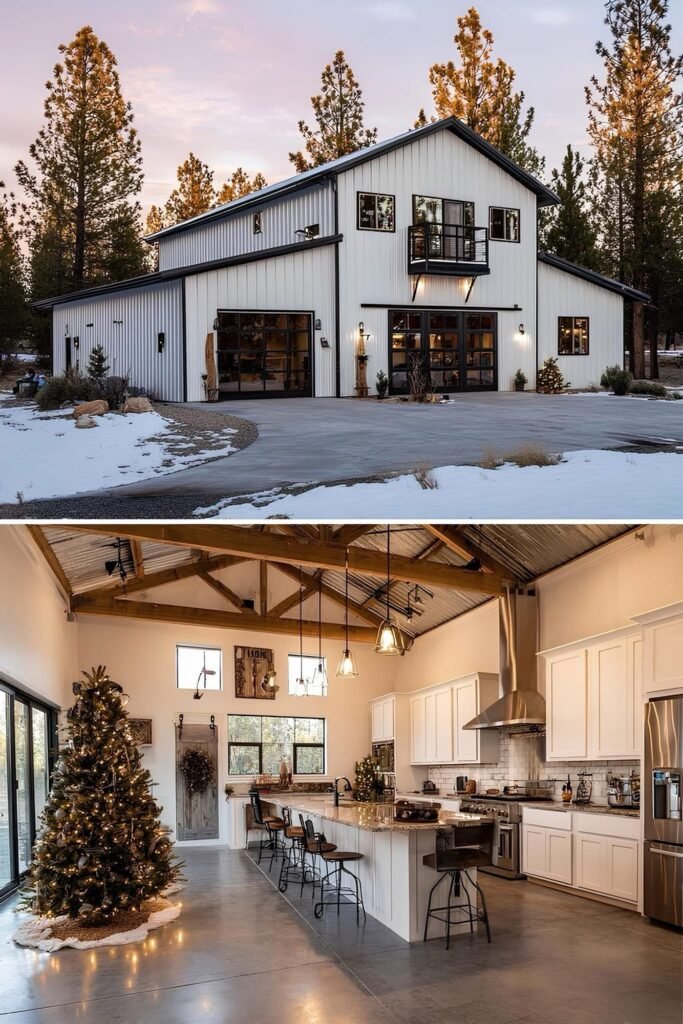
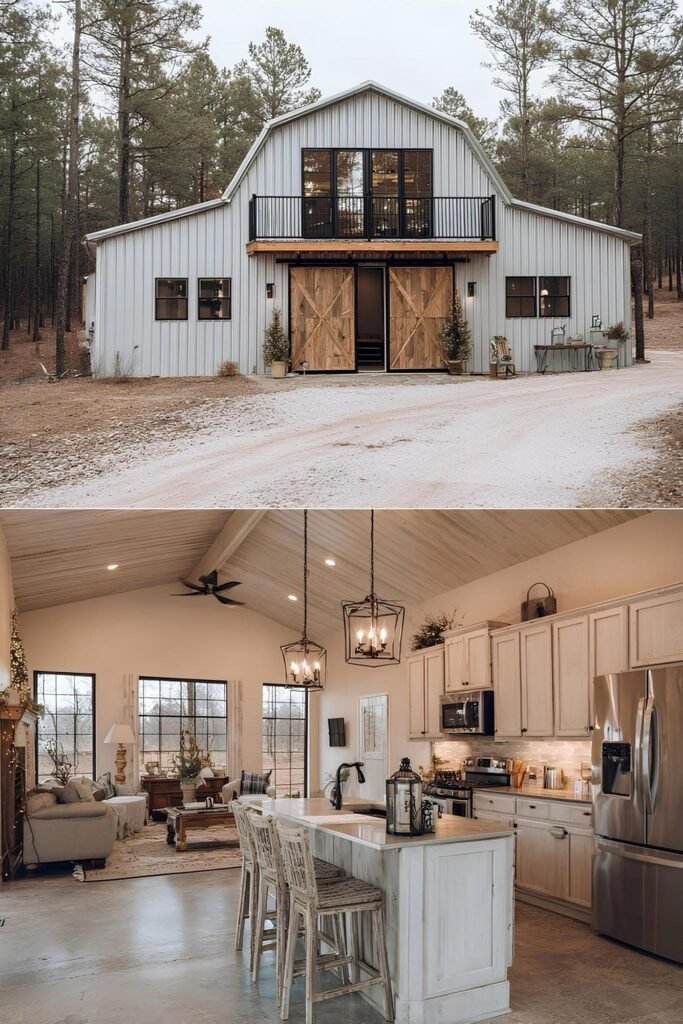
Barndominium 18
Estimated Build Cost: $355,000
Square Footage: 2,700 sq ft
Bedrooms/Bathrooms: 3 bed / 2.5 bath
Land Size: 1.8 acres
Notes: $355K, 2,700 sq ft home on 1.8 acres with white siding, upper balcony, sliding barn doors, and centered entry design.
The best barndominium floor plans — including the ones you’ll see in this article — balance the desire for open, light-filled spaces with practical decisions about where to put glass and how to manage the resulting heat gain or loss. That’s not something a generic floor plan template gets right automatically. It takes someone who understands how these buildings perform.
Interior layout is another place where barndominium planning diverges from conventional home design. The clear-span structure of a post-frame building means you can place walls wherever the floor plan calls for them, without worrying about load-bearing partitions the way you would in a wood-frame house. That’s a genuine advantage — but it also means the floor plan has to carry more of the design work. A poorly laid-out barndominium with 2,400 square feet can feel cramped and awkward. A well-laid-out one with 1,800 square feet can feel spacious and functional. Square footage alone doesn’t tell the story.
Barndominium 19
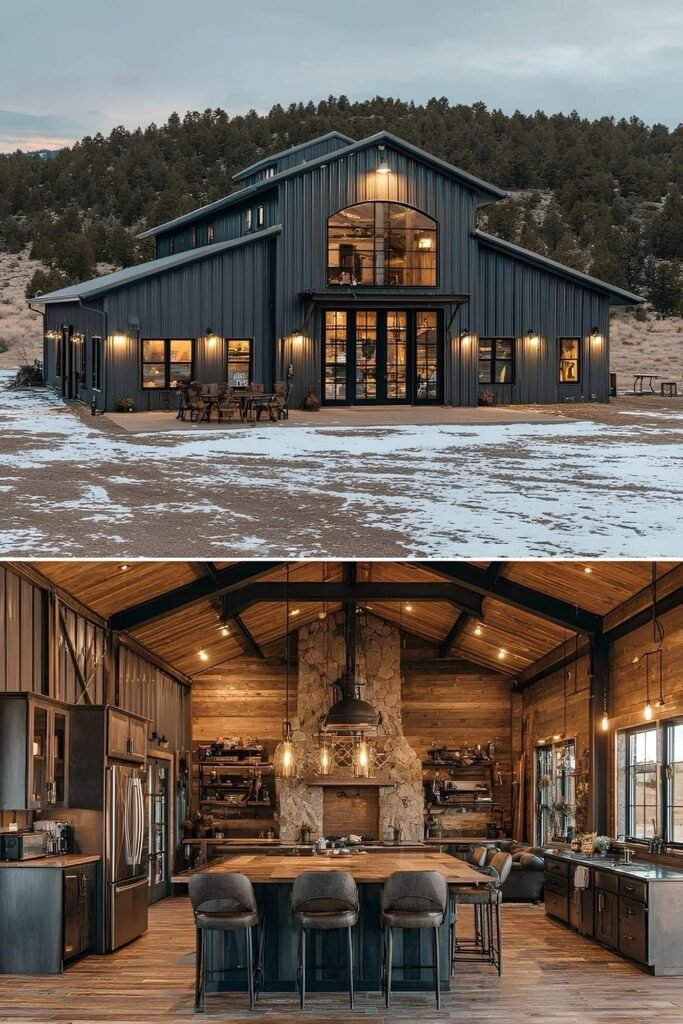
Estimated Build Cost: $460,000
Square Footage: 3,500 sq ft
Bedrooms/Bathrooms: 4 bed / 3.5 bath
Land Size: 3 acres
Notes: $460K, 3,500 sq ft home on 3 acres with dark siding, large arched window, extended wings, and open rural landscape.
Barndominium 20
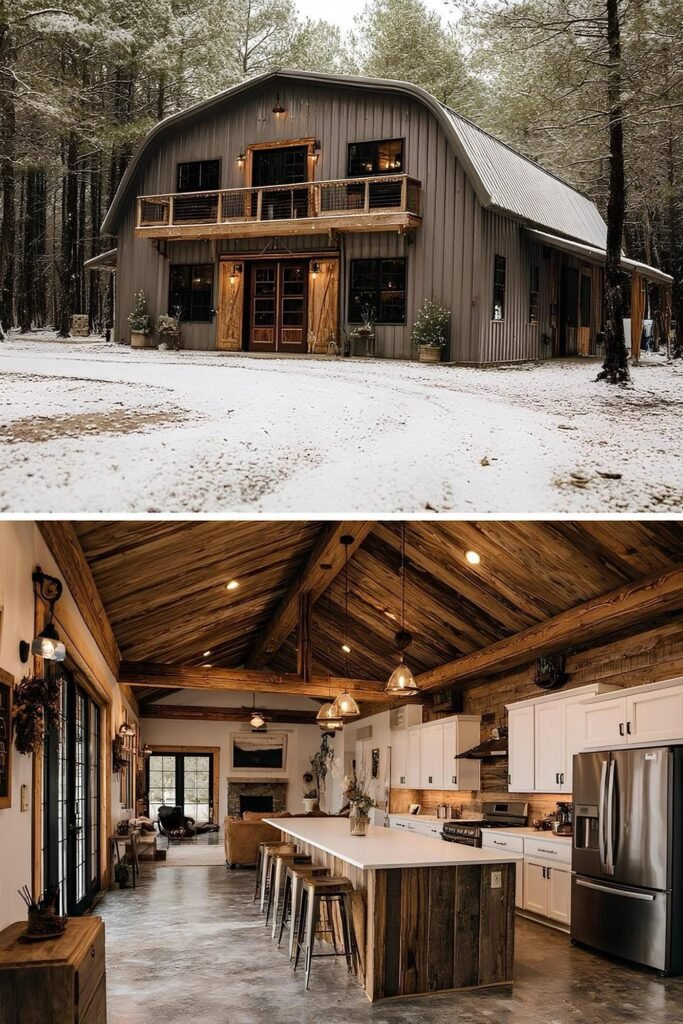
Estimated Build Cost: $410,000
Square Footage: 3,200 sq ft
Bedrooms/Bathrooms: 4 bed / 3 bath
Land Size: 2.6 acres
Notes: $410K, 3,200 sq ft home on 2.6 acres with curved roofline, upper balcony, wood accents, and quiet wooded setting.
Integrated Shop Spaces — Worth It, But Plan It Right
One of the defining features of a true barndominium is the integrated shop, garage, or workspace. This is different from a detached garage — the shop shares the roofline and structure of the home, which has real advantages for heating, insulation continuity, and daily convenience. But it also creates complications that a standard home builder won’t anticipate.
Fire separation walls between the living space and the shop are typically required by code, and the requirements vary by jurisdiction. Some counties require a one-hour rated assembly, others require two hours. In a metal post-frame building, achieving that rating requires specific wall assemblies that need to be engineered and documented. This isn’t something to figure out during construction — it needs to be in the plans before the permit application goes in.
Barndominium 21
Estimated Build Cost: $395,000
Square Footage: 3,100 sq ft
Bedrooms/Bathrooms: 4 bed / 3 bath
Land Size: 2.1 acres
Notes: $395K, 3,100 sq ft home on 2.1 acres with gray siding, large glass garage door, long porch, and clean barn-style form.
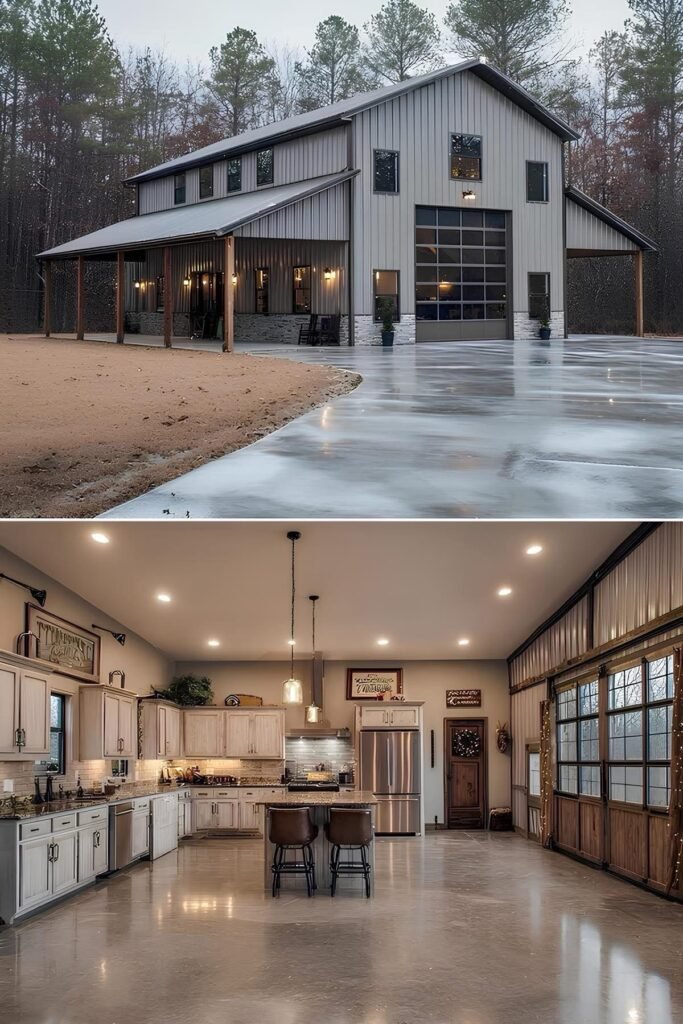
Shop door size is another decision that’s worth more thought than it usually gets. A 14-foot tall door accommodates most RVs and boats. A 12-foot door handles pickups and trailers. If your plan shows a 10-foot door, make sure that matches the actual equipment you intend to park there, because changing a post-frame opening after the building is erected is expensive.
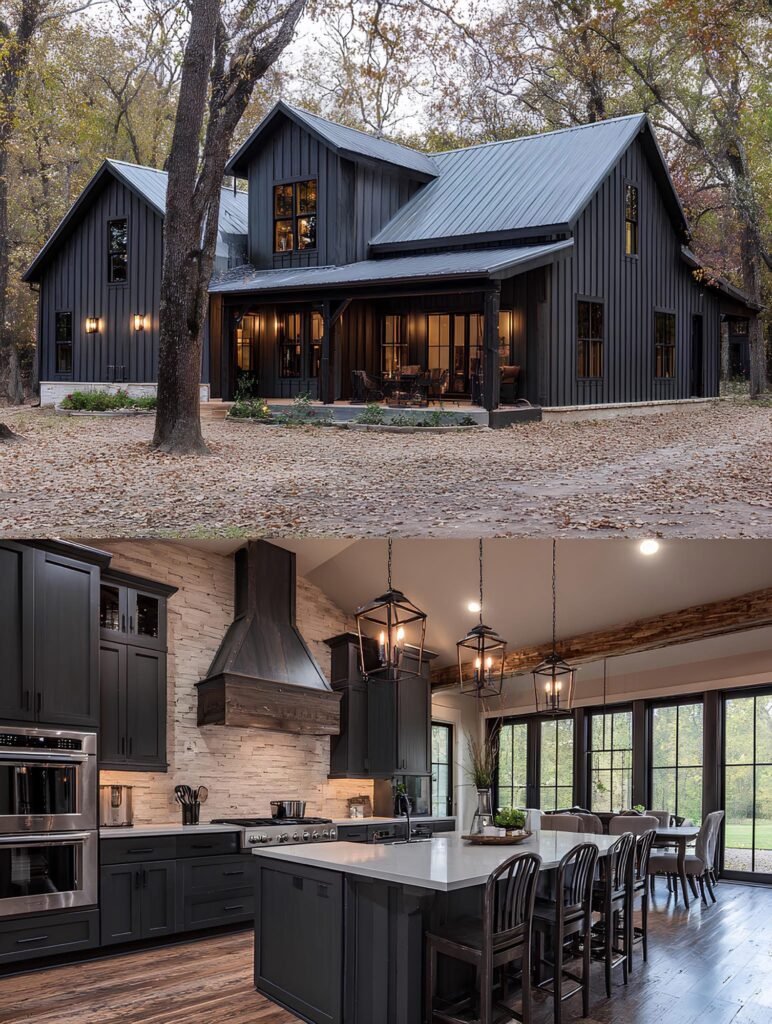
Barndominium 22
Estimated Build Cost: $440,000
Square Footage: 3,300 sq ft
Bedrooms/Bathrooms: 4 bed / 3 bath
Land Size: 2.5 acres
Notes: $440K, 3,300 sq ft home on 2.5 acres with dark vertical siding, multi-gable roof, covered patio, and wooded surroundings.
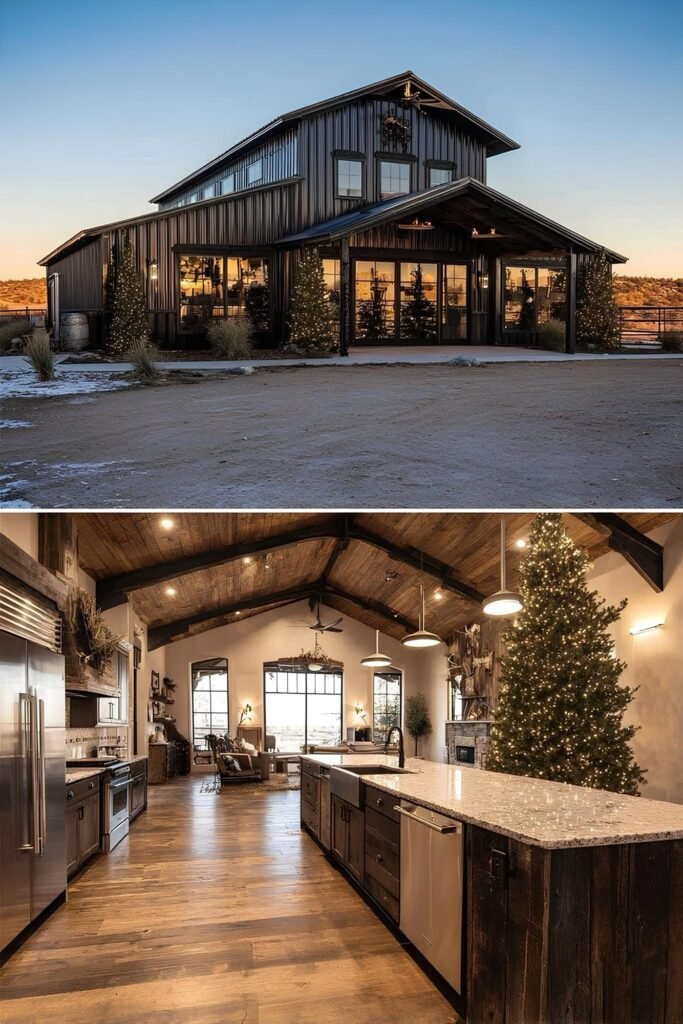
Barndominium 23
Estimated Build Cost: $450,000
Square Footage: 3,400 sq ft
Bedrooms/Bathrooms: 4 bed / 3.5 bath
Land Size: 3 acres
Notes: $450K, 3,400 sq ft home on 3 acres with dark metal siding, layered rooflines, large windows, and open countryside setting.
Financing the Shop Space — A Known Sticking Point
Lenders who are unfamiliar with barndominiums sometimes struggle with how to value the shop portion of the building. If the shop represents 40 percent of the total square footage, an appraiser who doesn’t know how to handle it may try to assign it a much lower per-square-foot value than the living space — which tanks the appraised value and kills the loan.
The fix is working with a lender who has done this before and who orders appraisals from appraisers with specific barndominium experience. Ask the lender directly: “Can you name a recent barndominium appraisal your firm has ordered in this region?” If they can’t, keep looking.
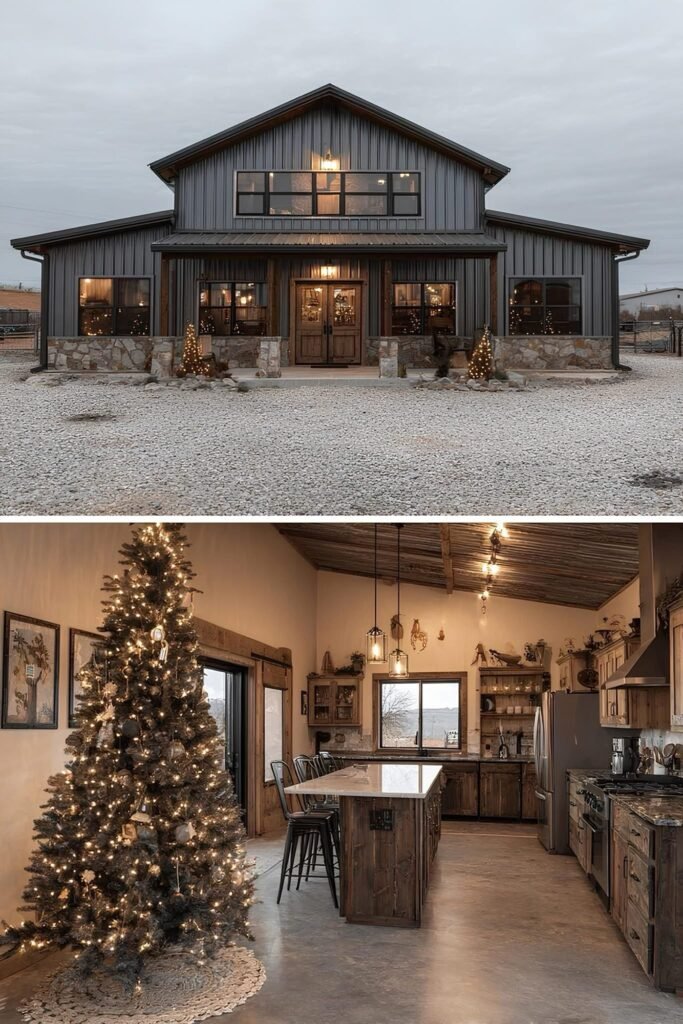
Barndominium 24
Estimated Build Cost: $400,000
Square Footage: 3,100 sq ft
Bedrooms/Bathrooms: 4 bed / 3 bath
Land Size: 2.3 acres
Notes: $400K, 3,100 sq ft home on 2.3 acres with gray siding, stone base, centered entry, and balanced symmetrical frontage.
Barndominium 25
Estimated Build Cost: $455,000
Square Footage: 3,400 sq ft
Bedrooms/Bathrooms: 4 bed / 3 bath
Land Size: 3 acres
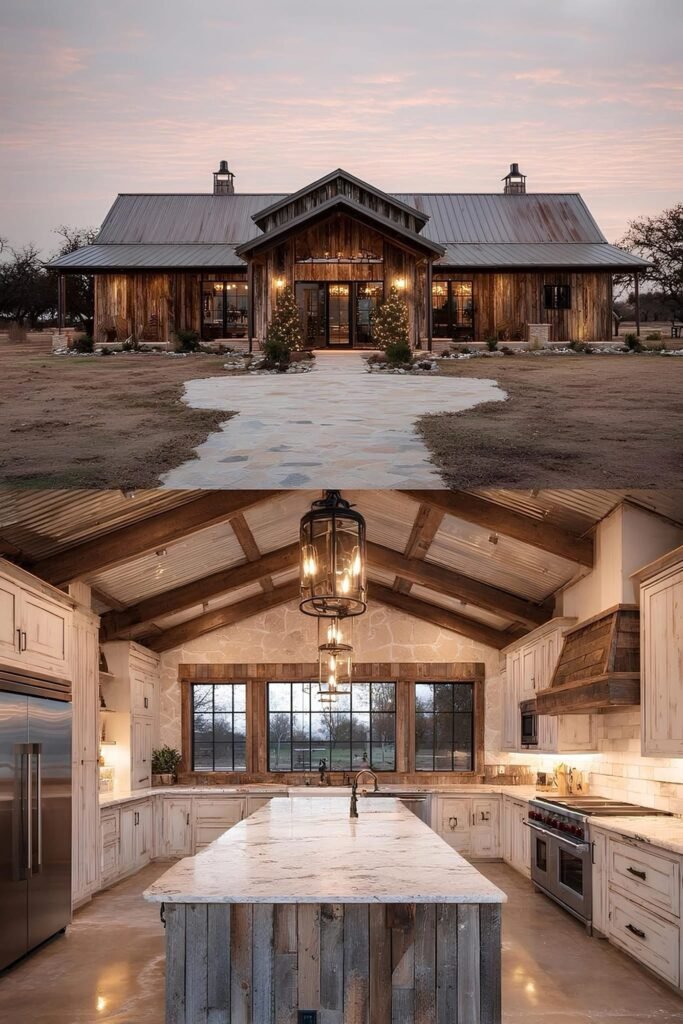
Notes: $455K, 3,400 sq ft home on 3 acres with reclaimed wood exterior, twin chimneys, central entry, and wide open rural setting.
Some buyers handle this by deliberately designing the shop to read as a garage — standard garage doors, drywall on the interior, proper separation wall — rather than an agricultural space. The cosmetic distinction can make a meaningful difference in how an appraiser categorizes and values the square footage.
Barndominium 26
Estimated Build Cost: $470,000
Square Footage: 3,600 sq ft
Bedrooms/Bathrooms: 4 bed / 3.5 bath
Land Size: 3 acres
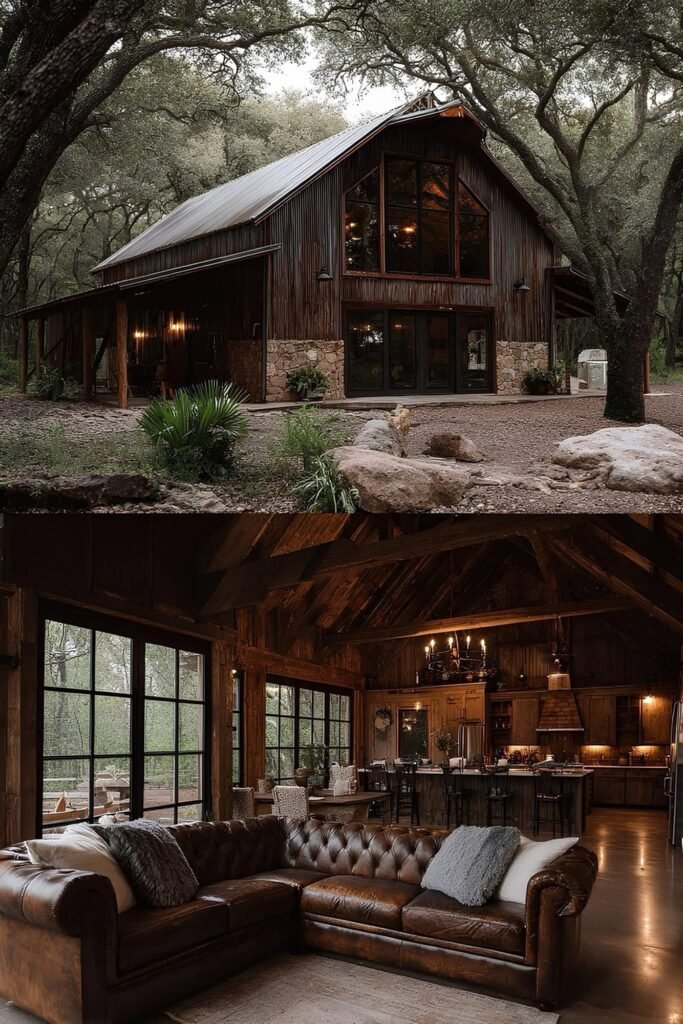
Notes: $470K, 3,600 sq ft home on 3 acres with dark wood siding, tall glass facade, stone base, and dense wooded surroundings.
Insulation — Don’t Cut Corners Here
Open-cell spray foam, closed-cell spray foam, and rigid board insulation all get used in barndominium construction, and the right choice depends on your climate zone, your budget, and your wall assembly. In a hot, humid climate like much of the South, closed-cell spray foam on the metal panels prevents condensation and mold better than anything else on the market. In a dry climate, you have more flexibility.
What you don’t want to do is insulate a metal building with fiberglass batts alone. The thermal bridging through the steel framing members defeats much of the benefit, and you end up with an uncomfortable house and high utility bills. That’s a problem that’s expensive to fix after the fact.
Barndominium 27
Estimated Build Cost: $340,000
Square Footage: 2,600 sq ft
Bedrooms/Bathrooms: 3 bed / 2 bath
Land Size: 2 acres
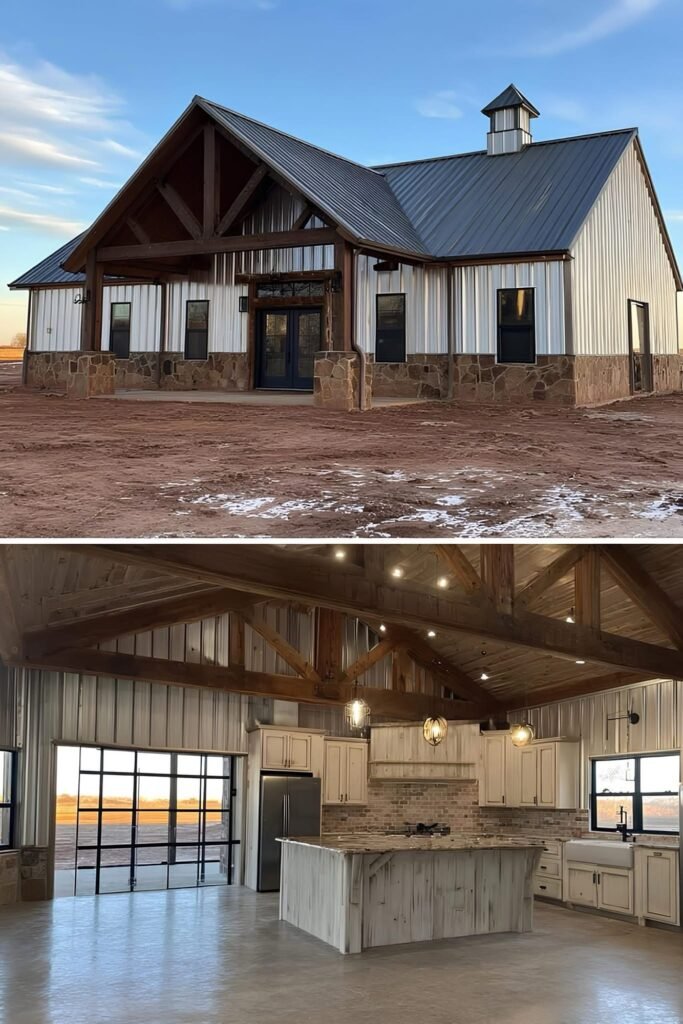
Notes: $340K, 2,600 sq ft home on 2 acres with light metal siding, stone base, timber entry frame, and simple rural layout.
Barndominium 28
Estimated Build Cost: $315,000
Square Footage: 2,200 sq ft
Bedrooms/Bathrooms: 3 bed / 2 bath
Land Size: 1.5 acres
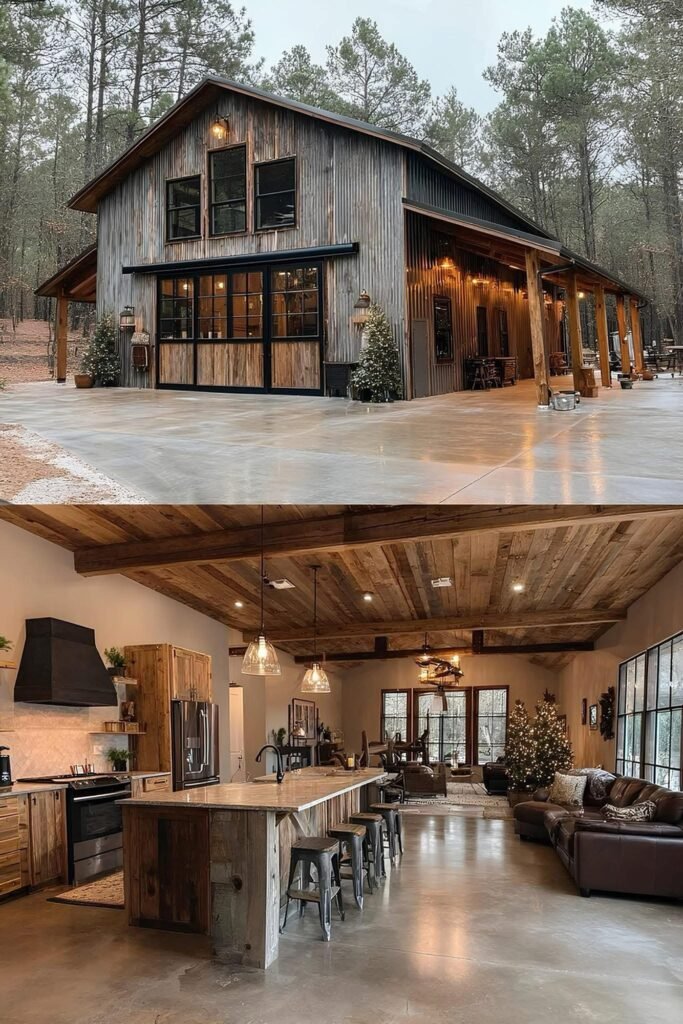
Notes: $315K, 2,200 sq ft home on 1.5 acres with weathered metal siding, wraparound porch, oversized garage door, and warm open-concept interior with rustic wood finishes.
Budget somewhere between $3 and $7 per square foot for proper insulation in a barndominium. On a 2,500 square foot building, that’s $7,500 to $17,500 — real money, but significantly less than what poor insulation will cost you in energy bills over five or ten years.
A note on vapor barriers: in humid climates, the location of the vapor barrier in your wall assembly is critically important and often misunderstood by builders who don’t regularly work with metal buildings. The dew point inside the wall cavity needs to stay outside the insulation layer, not inside it. If a builder proposes a wall assembly that puts the vapor barrier on the wrong side for your climate zone, that’s a red flag worth pushing back on. Ask them to explain why they’re specifying it that way. A good builder will have a real answer.
Barndominium 29
Estimated Build Cost: $355,000
Square Footage: 2,500 sq ft
Bedrooms/Bathrooms: 3–4 bed / 2.5 bath
Land Size: 2 acres
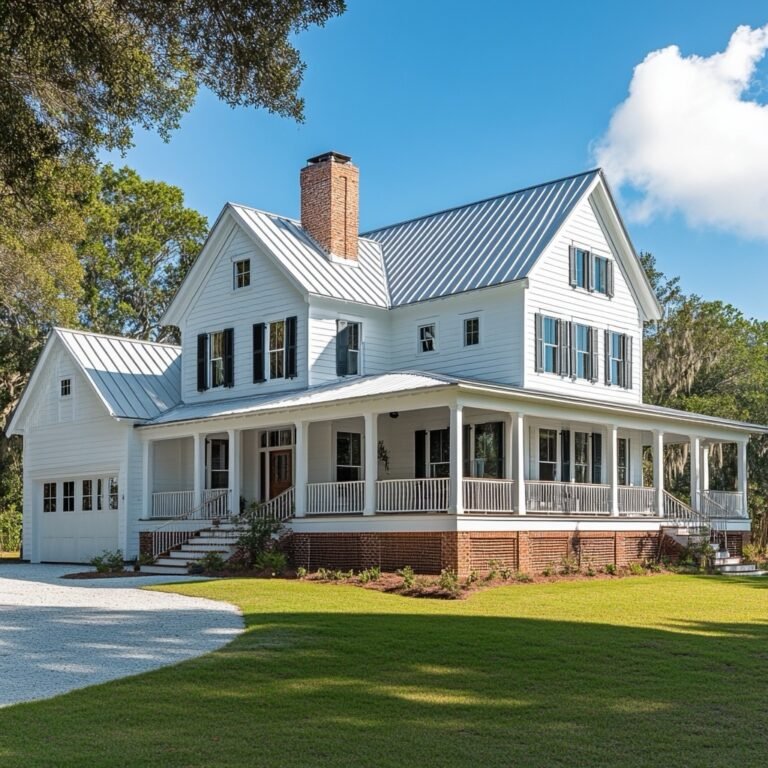
Notes: $355K, 2,500 sq ft home on 2 acres with a balanced ranch-style layout, stone and wood exterior, wide front porch, and a warm interior featuring custom wood cabinetry, vaulted ceilings, and a large central kitchen built for gathering.
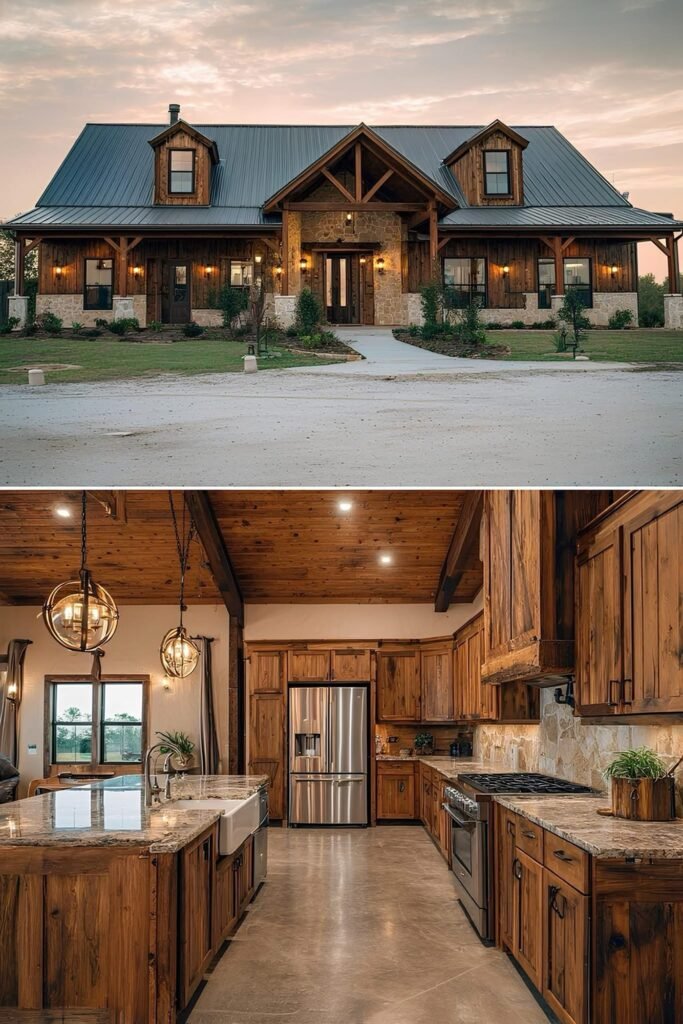
Barndominium 30
Estimated Build Cost: $385,000
Square Footage: 2,800 sq ft
Bedrooms/Bathrooms: 4 bed / 3 bath
Land Size: 2–3 acres
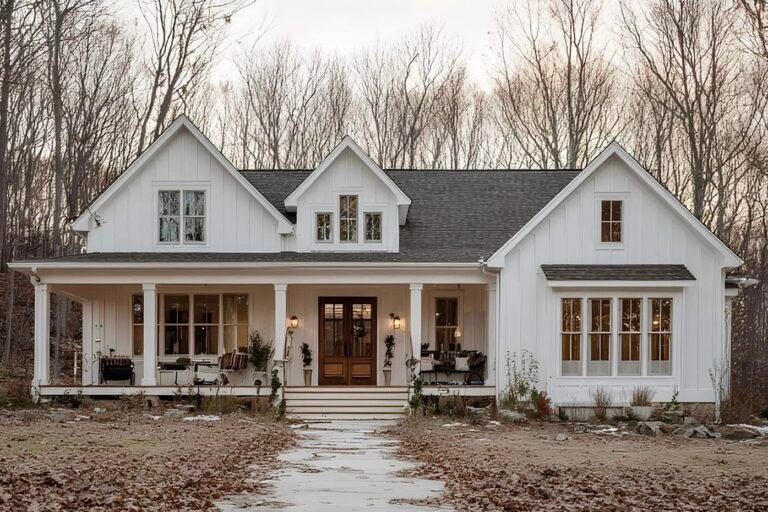
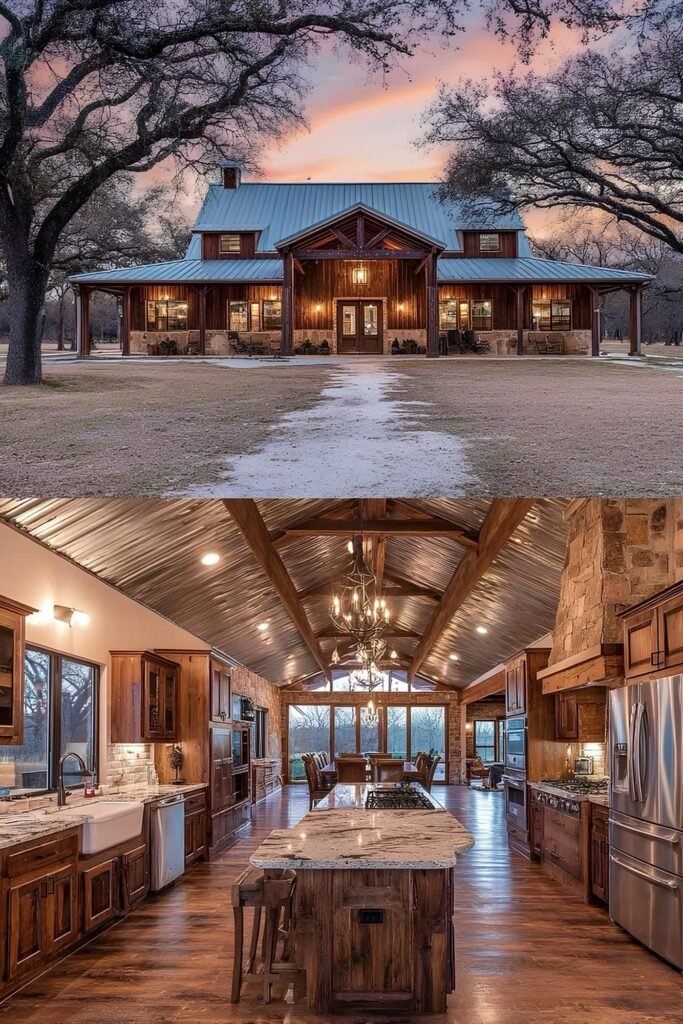
Notes: $385K, 2,800 sq ft home on 2–3 acres with a symmetrical farmhouse layout, extended wraparound porch, and a striking interior featuring a long vaulted ceiling, exposed beams, stone accents, and a central kitchen designed as the focal point of the home.
Pulling It All Together — Building Under $500K Without Losing Your Mind
The barndominium owners who come out of the build process happy — on budget, in a house they love, with financing that didn’t take years off their life — all have one thing in common. They planned longer and built faster. They spent time on the front end getting the floor plan right, understanding their site costs, talking to multiple lenders before choosing one, and working with a builder who had done this before.
The designs in this article aren’t theoretical. They’re real plans built by people who understand how post-frame construction works, how lenders think about these properties, and how to design a home that performs well and holds its value. The floor plans are available because the goal isn’t just to show you a picture — it’s to give you something you can actually build.
If you want to get the floor plan for any of the barndominiums featured in this article, reach out directly to aycustomhomedesign@gmail.com. Tell us which design caught your eye and we’ll get you the details. These aren’t stock plans repurposed from somewhere else — they’re designed specifically for people who want to build smart, build right, and build within a real-world budget.
The financing exists. The designs exist. The path forward is more straightforward than most people realize once you have the right information and the right team around you. Don’t let an unfamiliar loan process or an appraiser who has never seen a barndominium stop you from building something that fits your life. The people who figure this out kept asking the right questions until they got answers that made sense. This guide is a starting point — your lender, your builder, and your floor plan will take you the rest of the way.